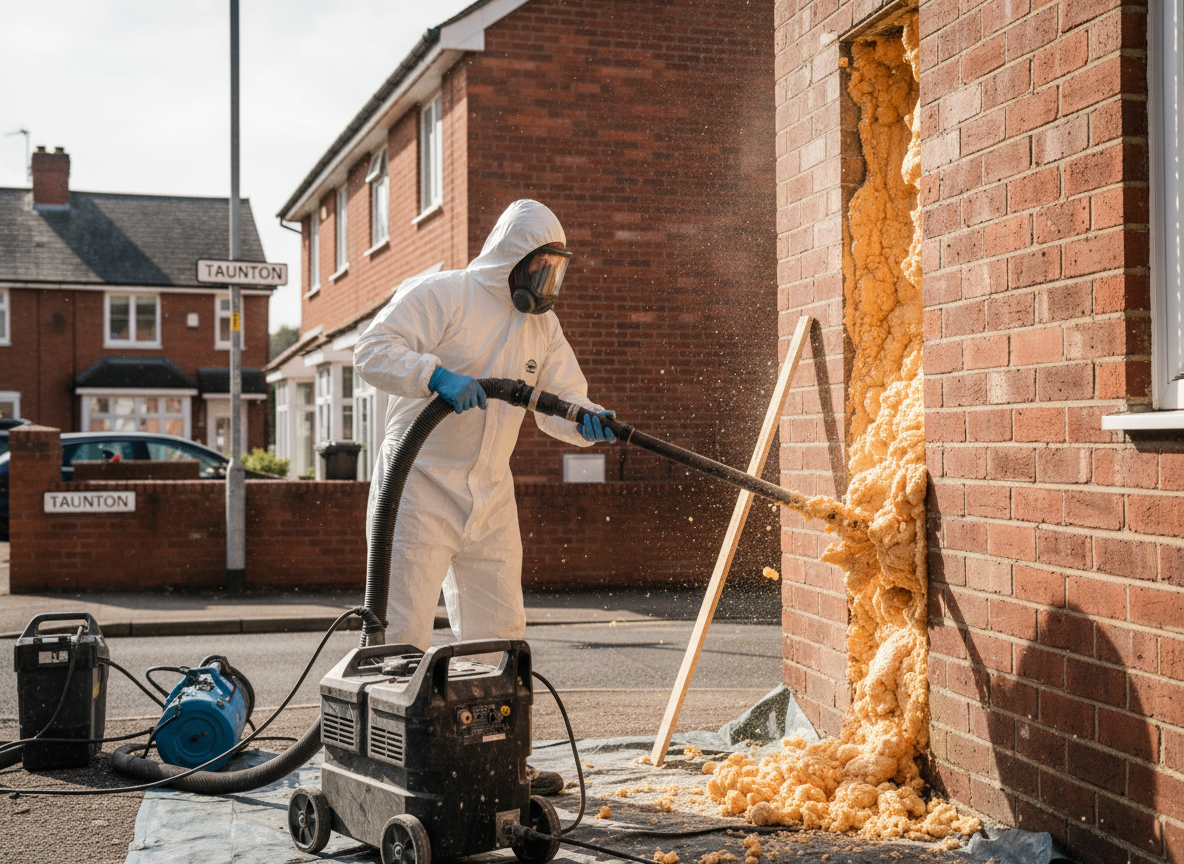
Cavity wall spray foam was widely installed in Taunton homes built between the 1920s and 1970s, particularly in terraces along Staplegrove Road and nearby Victorian streets. Over time the closed-cell material traps moisture against brickwork, especially during the county's frequent autumn and winter rainfall. Removal requires careful drilling and extraction to avoid damaging the inner leaf or pushing debris into ventilation paths that run under many local suspended timber floors.
Somerset soil holds water longer than surrounding counties, so foam left in place often leads to rising damp once the original wall vents become blocked. Technicians must map each property's cavity depth on site because Taunton's mixed stock includes both narrow 50 mm voids in Edwardian semis and wider 100 mm gaps in post-war council houses. Incorrect pressure during extraction can force residue into electrical chases or chimney breasts still common in the TA1 postcode.
Local building control expects any reinstated insulation to meet current ventilation standards, which older foam installations rarely satisfy. Work around Staplegrove and the town centre also involves coordinating with narrow access lanes where larger vacuum rigs cannot be positioned, requiring smaller portable units and longer hose runs that extend job duration.
Homeowners in Taunton often discover the problem only after internal plaster shows staining or when a mortgage survey flags the foam. Early removal prevents further salt migration through the brickwork and allows proper inspection of wall ties that have corroded faster in the damp local microclimate.
Technician insight
In Taunton the thing that catches most people out with cavity wall spray foam removal is how quickly the foam has bonded to the inner brick in older terraces near the river; the frequent heavy rain means any missed residue turns into a damp patch within weeks once the vents are reopened.
Cavity foam removal in a Staplegrove terrace
A 1930s mid-terrace near Staplegrove Road showed persistent damp on the party wall. Inspection found the original foam had absorbed water from blocked air bricks and migrated into the floor void. We drilled staggered access points, extracted the saturated material in sections, cleared the vents, and left the cavity clean for future insulation.
How it works
- 1
Site Survey and Cavity Mapping
Technicians visit the Taunton property to measure cavity depth, locate vents, and identify any shared walls with neighbouring homes.
- 2
Controlled Drilling and Extraction
Small access holes are drilled at calculated intervals; industrial vacuums remove the foam without disturbing the inner wall leaf.
- 3
Debris Clearance and Vent Restoration
All residue is extracted, original air bricks are cleared, and cavities are inspected for remaining insulation or blockages.
- 4
Final Inspection and Advice
The team checks for damp ingress and provides guidance on suitable replacement insulation that suits Somerset weather patterns.
Pricing
Cost depends on property size, cavity depth and access restrictions typical in Taunton terraces; 24/7 availability for urgent damp cases.